

Latest Google Ads Changes & Updates: What Advertisers Need to Know This Year
Google Ads continues to evolve rapidly, with automation, AI, and privacy-first advertising shaping how campaigns are created, optimized, and measured. What began years ago with interface changes and new ad formats has now matured into a fully AI-driven advertising ecosystem.
Below is a refreshed overview of key Google Ads changes and updates advertisers should focus on this year, along with how they impact performance.
Major Google Ads Updates You Should Know About
1. AI-Driven Campaigns Take Center Stage
Google is increasingly prioritizing automation across campaign types. Performance Max, Demand Gen, and AI-powered Search campaigns now dominate account structures.
Key highlights:
-
Automated bidding and budget allocation
-
Asset-based ad creation instead of keyword-only ads
-
Real-time optimization across Search, Display, YouTube, Discover, Gmail, and Maps
👉 Advertisers who provide strong creative assets and conversion signals see the best results.
2. Expanded Use of Performance Max & Demand Gen Campaigns
Performance Max campaigns are no longer optional—they are central to scaling conversions. Demand Gen campaigns have replaced traditional Discovery ads and are designed for mid-funnel engagement using visually rich formats.
Benefits:
-
Wider reach across Google properties
-
Better audience expansion using intent signals
-
Improved conversion volume when paired with quality creatives
3. Search Ads Continue to Shift Toward Broad Match + Smart Bidding
Google now strongly encourages:
-
Broad match keywords
-
Smart bidding strategies like Maximize Conversions and Target ROAS
Exact match keywords still exist, but Google interprets them more flexibly based on intent rather than wording alone. Advertisers must rely more on search term analysis, negative keywords, and conversion quality.
4. New Metrics Replace Legacy Measurements
Older metrics like average position are long gone. Instead, advertisers now rely on:
-
Search Top IS
-
Search Absolute Top IS
-
Impression Share Lost (Budget & Rank)
These metrics provide clearer insights into:
-
Visibility above organic results
-
Missed opportunities due to low budget or ad rank
-
Where optimization is actually needed (quality vs spend)
5. Creative Quality Is Now a Ranking Factor
Ad strength, asset variety, and creative relevance directly influence delivery.
Best practices include:
-
Multiple headlines and descriptions
-
High-quality images and videos
-
Clear CTAs and benefit-driven messaging
-
Regular creative refreshes
Google now rewards advertisers who test frequently and maintain “Excellent” ad strength.
6. Video & YouTube Ads Are Conversion-Focused
YouTube is no longer just for awareness. With formats like:
-
Video action campaigns
-
Short-form vertical video
-
Demand Gen video placements
Advertisers can now drive leads, purchases, and app installs directly from video campaigns.
7. Privacy-First Advertising & First-Party Data
With cookies fading and privacy regulations increasing, Google Ads now emphasizes:
-
First-party data
-
Enhanced conversions
-
Consent Mode v2
-
CRM and offline conversion uploads
Advertisers who integrate their data with Google Ads gain stronger attribution and smarter optimization.
What This Means for Advertisers
Google Ads today is less about manual control and more about:
-
Strategic inputs
-
High-quality creatives
-
Accurate conversion tracking
-
Strong landing page experience
Those who resist automation struggle. Those who guide it correctly scale faster and more profitably.
Final Thoughts
Google Ads has transformed into an AI-driven performance engine. Staying competitive means adapting to automation, embracing new metrics, and focusing on creative excellence rather than outdated tactics.
At Leads Dubai, we stay ahead of every Google Ads update—big or small—so our clients always benefit from the latest strategies, smarter targeting, and better ROI.
👉 Want help optimizing your Google Ads campaigns with the latest updates?
Talk to our Google Ads experts in Dubai today.
Top Adwords Changes. What to expect Next.
It has been a remarkable year and it has been most eventful for the marketing world, especially regarding AdWords. We discuss top AdWords changes. There were numerous alterations, from new features to platform re-design and lots of strategic adjustments.
Here are some of the Top Adwords Changes
The new experience with Google AdWords:
The top change in AdWords is the platform itself. The updated user interface of AdWords boasts of a slew of fresh features such as potent data visualizations, enormously enhanced workflow, and options for extra demographic targeting. While most advertisers have access to the new AdWords platform, if you are not up to it, you can still cling to the old version.
More value for PPC
At different points every year, the value of PPC’s ads is questioned. Some feel that if they rank high organically on SERP, there is no need to waste money on PPC since people can find them already. But this is not true: over the last 2 years, the value of the #1 ranking has declined by an amazing 37%. Thus AdWords ads have become more crucial for online advertising of businesses.
More changes to Google ad spend
From October 4, 2017, marketing campaigns will be able to spend twice the average daily budget for helping to reach advertising goals. Google significantly changed the way budget is allocated through the course of a given month, capping it at 20%.
Running ad variations in Google AdWords
Split testing is a major headache for all AdWords users and is particularly taxing for owners of small businesses. They have no time to redesign ad copy. So Google introduced the interface of Ad Variations as part of the fresh AdWords experience. This new feature permits you to find and replace keywords, update complete portions of your ad and change your headlines.
Exact match keywords for Google AdWords
They have been the conversion driving force behind several AdWords accounts. They provided a big level of control which helped make easy tailoring ads and copying of landing page.
But in Q1, Google changed the way it defines exact match keywords, choosing to widen its scope. AdWords “Best” + “Right now” ignores, removes, or adds function words to match your keywords to target exact match keywords. By this, over 18% of active exact match keywords became superfluous.
Hot deals and Promotion Extensions
Ad extensions and hot deals are both loved by SEMs. Both have been blended together by Google. In October, Google ultimately launched Promotion Extensions to all AdWords accounts.
If you want to know about the latest google ads announcements, check here. Also read about the latest google ads updates here
These are some top AdWords changes made by Google. Check our Google Adwords Blogs where we talk about other hot PPC topics
Some previous Years Google Ads Updates –
Google Keyword Planner
Keyword Planner can provide some great keyword ideas and traffic forecasts, campaign performance depends on a variety of factors. You can use Keyword Planner to accomplish the following tasks:
- Research keywords. You can search for keywords based on terms that are relevant to your product or service, website, or landing page. This gets you the demand in the market for your services.
- Get forecasts. Learning more about predicted clicks and estimated conversions can give you an idea of how a list of keywords might perform for a given bid and budget.
Google ads Add-on for Google Sheets
Worried about google ads reporting? How cool it would be if it were automatically created with the key information you wanted?
The google ads add-on for Google Sheets makes it easy for you to create, run, and update your google ads reports in Google Sheets. All you have to do is to open your google sheet with the same google ads login account and install this add-on. You can:
- Quickly and easily create google ads reports in Google Sheets.
- Refresh reports quickly, instead of running multiple reports and copying and pasting data.
- Share reports with your team.
- View, create, and modify report definitions from within Google Sheets. and much more…
With Google Ads’ growth, the “average position” metric was eliminated, altering how success is measured by advertisers. Follow us below to learn how to optimize your campaigns utilizing the new Google Ads metrics—step by step.
How to Optimize Google Ads When Average Position Disappears
Step-by-step instructions to Optimize Google Ads New Metrics When Average Position Disappears
Google has reported that the “average position” metric will never again be upheld beginning in September.
The retirement of one of the most seasoned measurements positively appears as though it could have been gotten ineffectively.
Be that as it may, things being what they are, most sponsors approve of the declared change, particularly in light of a portion of the new position measurements Google has acquainted with supplanting normal position.
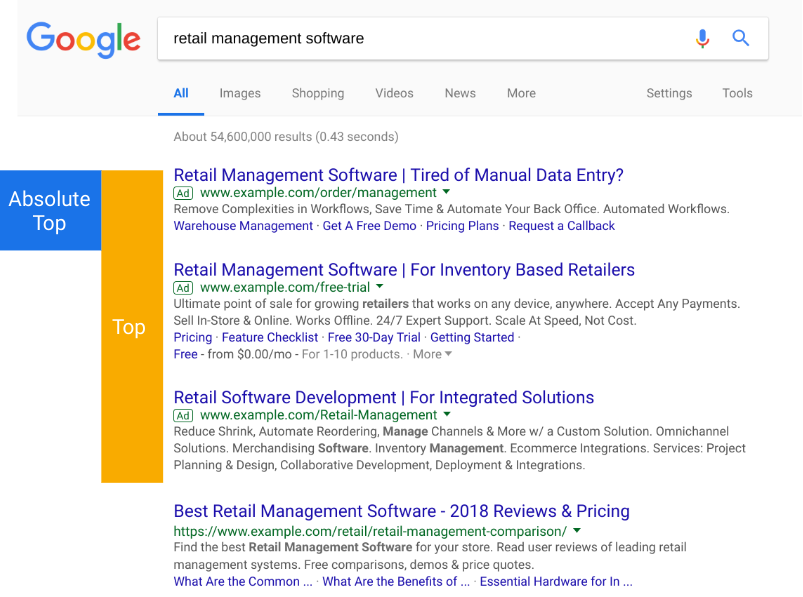
Here’s the manner by which the new “top” and “absolute top” measurements can complete a superior position than normal position ever could while directing publicists to enhance their PPC accounts.
To start with, here are the new measurements Google presented in the previous year that they feel can enable sponsors to all the more likely see how their promotions are getting along, and that is subsequently observed as the swap for the normal position metric is being resigned.
Measurements to Understand How Often Your Ad Was at the Top or Absolute Top When It Was Shown – Google Ads New Metrics
- “Impr. (Abs. Top) %” – The percentage of received impressions that were at the very top of the page
- “Impr. (Top) %” – The percentage of received impressions that were above the organic results
Google Ads New Metrics – Understand Opportunities to Get More Impressions at the Top
- “Search absolute top IS” – The percentage of opportunities to appear at the absolute top you’re actually turning into impressions in that space.
- “Search top IS” – The percentage of opportunities to appear above the organic results you’re actually turning into impressions in that space.
Google Ads New Metrics – Understand What Optimization to Do
Budget and rank are the two factors for losing impression share at the top or absolute top.
- Search lost absolute top impression share (budget)
- Search lost absolute top impression share (rank)
- Search lost top impression share (budget)
- Search lost top impression share (rank)
Scenario 1: Only ads that meet the relevance threshold can show at the top
- Advertiser 1: position 4 (the final ad above the organic results)
- Advertiser 2: position 4 (the first ad below the organic results)
For Both advertisers, it’s showing the ads are in an average position of 4.0
But for one, it’s an impression above organic results and for a second it’s an impression below organic results. Therefore, only one advertiser gets a better fare than the other.
The reason for this: The Ad to appear depends upon other factors too: Location, The Landing page/website relevancy, and Ad Rank/ Quality Score.
If the ad copy is not meeting certain relevancy requirements it may still be shown on the first page but not be promoted above the organic results and will be positioned below organic results.
So, Now this Google Ads new Metrics introduced will help? Let’s see how?
With this new Impressio Top % metric – an advertiser can understand whether their ads were good enough and meet those relevancy requirements.
In the above-stated example above, the advertiser whose ad was in position 4 and shown at the top of the page would realize the quality of the ad.
And the second advertiser, being in the same position, will now be able to access their ad doesn’t qualify for the top-of-page promotion and that’s why appearing below organic results.
Scenario 2: 3 Advertisers with the same average but with different positions calculations.
- Advertiser 1: position 1 + 4 + 4 → avg. pos. 3
- Advertiser 2: position 2 + 3 + 4 → avg. pos. 3
- Advertiser 3: position 1 + 5 + not shown → avg. pos. 3
These advertisers could make better optimization decisions if they understood how their average position was attained.
How often were they shown at the top of the page and how often were they the absolute top ad?
Let’s see how these new metrics help them in optimization.
Advertiser 2 will never get the absolute top impression as they never were on Position 1 like others. And hence need to work more on quality scores.
For Advertiser 3 the impression top % is only 50%
When You Raise Bids to Get More IS but Instead Get Lower IS
PPC experts should be aware of the fact that when they increase the bids in order to fix Low Top IS it actually exacerbates the problem further and increase the IS loss.
The Reason for this: High Bids led the eligible keywords to participate more in auctions and in those new auctions, they may lose the more top impression than the current set of auctions.
This is as similar to how when we decrease the bids resulting in poor CPA. As There too it led to eligible keywords for fewer good auctions where conversion may have been more frequent.
We at Leads Dubai, Being Google Partner for Google Ads Services always keep our team up to date with each and every new small or big update being introduced and implement them in our campaign to give good and much better results to our clients.
With the average position metric removed and new performance insights on the scene, Google Ads is obviously changing. Let’s now examine the top future Adwords developments in 2025 and what advertisers can look forward to next.